
Exploring Alzheimer's Disease Across the Biological Continuum

CircRNAs provide molecular insight into the biological pathways associated with Alzheimer's across the full diseae continuum.

header graphic of brain image line drawing with networking dots connected throughout the image. faint line waves stretch across the screen behind it with a cluster of networking paths and dots to the left and the right of the brain image.

Alzheimer's Disease Biology Begins Long Before Symptoms

The biological processes underlying Alzheimer's disease begin years before cognitive symptoms emerge, creating opportunities to investigate disease biology long before clinical diagnosis.

Understanding this biological continuum, from cognitively unimpaired individuals through mild cognitive impairment (MCI) and Alzheimer's disease, is essential to advancing earlier detection, disease prediction, and therapeutic research.

Earlier biological insight may help researchers better understand disease progression, patient heterogeneity, and therapeutic response.

Alzheimer's Disease Through the A/T/N/X Framework

Alzheimer's disease is increasingly understood as a biologically complex disorder influenced by multiple interconnected pathological processes. The A/T/N/X framework provides a useful model for understanding these different dimensions of disease biology.

Growing evidence suggests that circRNAs reflect biological changes across the A/T/N/X spectrum, including amyloid and tau pathology, neurodegeneration, neuroinflammation, metabolic dysfunction, and oxidative stress. Emerging data also suggest these changes may occur early in the disease continuum, supporting investigation of preclinical and early-stage disease biology
A
Amyloid pathology
T
Tau pathology
N
Neurodegeneration
X
Additional disease mechanism
Emerging evidence suggests circRNA changes occur early in the disease continuum and are associated with biological processes spanning the full A/T/N/X spectrum.

A 34-circRNA Signature Across the Alzheimer's Disease Continuum

Research conducted in collaboration with leading Alzheimer's disease investigators identified a 34-circRNA biomarker signature associated with Alzheimer's disease biology.

Evaluated across multiple independent cohorts spanning cognitively unimpaired individuals, mild cognitive impairment (MCI), and Alzheimer's disease, the signature supports investigation of disease biology across the Alzheimer's disease continuum.

The 34-circRNA signature has demonstrated relevance across multiple stages of Alzheimer's disease progression.
~2,400
participants across three independent cohorts, validated in a landmark Nature Medicine study

Predicting Future Cognitive Decline Before Symptoms Appear

Alzheimer's disease biology begins years before cognitive symptoms emerge. Identifying individuals at risk during the preclinical stages of disease remains a major focus of prevention research, clinical trial enrollment, and early intervention strategies.

Research conducted at Washington University as part of the Knight Alzheimer's Disease Research Center (Knight ADRC) identified a 34-circRNA biomarker signature associated with future cognitive decline in cognitively unimpaired individuals.

Nature Medicine

Identifying and stratifying Alzheimer’s disease using circular RNA biomarkers in blood

The 34-circRNA signature identifies biological patterns associated with future cognitive impairment before symptom onset.

Published in Nature Medicine · July 2026
Review Full Publication
Cohort
WashU Knight ADRC
688
Cognitively unimpaired individuals at blood draw
Control
610 participants
Progressors
78
Lilly A4 replication cohort
676 samples
Validated across 1,796 samples for longitudinal monitoring and prediction of progression to AD
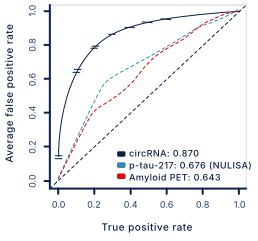
Progression of Pre-clinical Individuals to Symptomatic AD within 5 years
graph showing false positive rate vs true positive rates of circRNA, p-tau-217, and Amyloid PET
(N = 688; 610 Control & 78 progressors)
0.870
5-Year Progression AUC
vs. pTau217 alone at 0.676
2.92
Hazard Ratio
for progression to symptomatic AD (vs. 1.81x for pTau217)
4–8 yrs
Pre-Symptom Detection
circRNA divergence detectable before symptom onset
Phillips et al. (in press). Blood-Based Circular RNAs Enable Early and Accurate Alzheimer's Disease Diagnosis. Nature Medicine.

Identifying Biomarker-Confirmed Alzheimer's Disease

Identifying Alzheimer's disease biology remains a central focus of research, clinical trial enrollment, and therapeutic development.

Research conducted across multiple independent cohorts demonstrated that a 34-circRNA biomarker signature is associated with biomarker-confirmed Alzheimer's disease biology and can accurately distinguish individuals with Alzheimer's disease from cognitively normal controls.

A 34-circRNA signature accurately detects AD and distinguishes it from other neurodegeneration.

Nature Medicine

Identifying and stratifying Alzheimer’s disease using circular RNA biomarkers in blood.

The34-circRNA signature identifies biological patterns associated with future cognitive impairment before symptom onset.

Published in Nature Medicine · July 2026
Review Full Publication
Discovery Cohort
WashU Knight ADRC
1,221
Individuals across the full AD continuum
Orthogonal biomarker data available:
• Amyloid PET • Tau PET
• CSF biomarkers • Plasma pTau217
• Longitudinal clinical follow-up
0.945
AUC
for biomarker confirmed AD (CSF Aβ42/pTau181)
Highly specific
for Alzheimer's Disease
near random performance for non-AD dementias (PD, DLB, FTD)

Advancing Alzheimer's Disease Research

Progress in Alzheimer's disease research depends on collaboration across researchers, clinicians, institutions, and industry partners.

At Circular Genomics, we are committed to advancing circRNA research alongside the broader Alzheimer's disease community to expand understanding of disease biology and support the future of precision neurology.